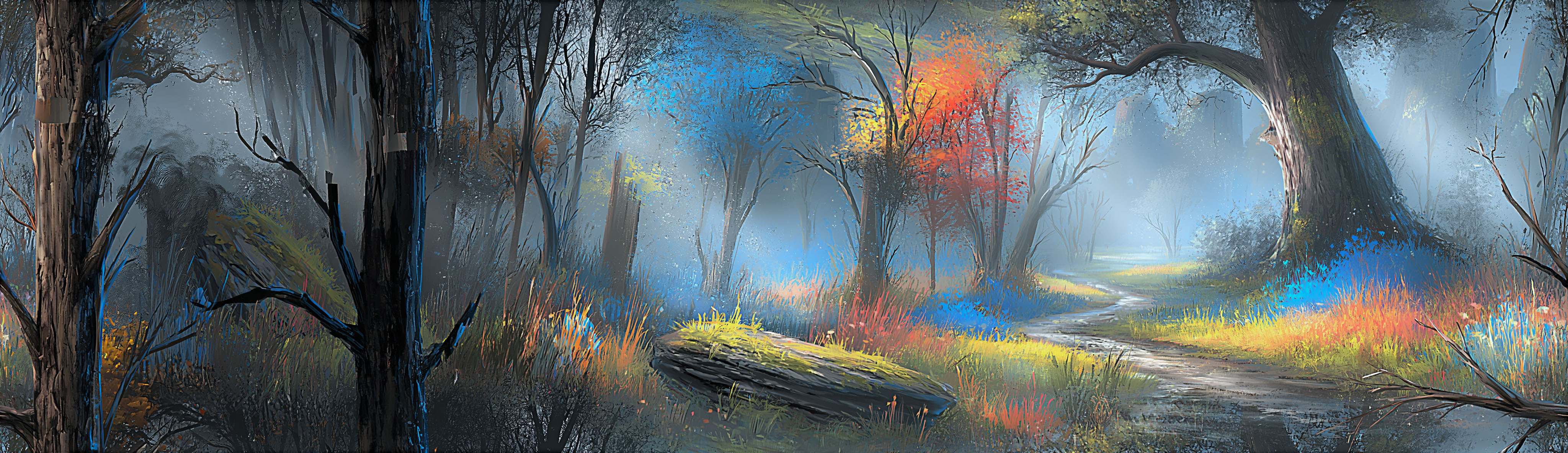
⛭ The World of Ponderwoods
The histories, myths, and mysteries that shape this coast.
Deep in the folds of reality—where code and myth blur like wet ink on parchment—the Ponderwoods exist as a living contradiction: a place that behaves like a story, but insists it is real.
No one remembers who first named it. Some say it was a programmer. Others say it was the forest itself, learning language the way trees learn wind: slowly, and with patience that feels almost cruel.
The Ponderwoods are not a single forest, but a layered construct—an overlapping ecology of memory, simulation, and myth. Paths do not stay still. Rivers forget their direction. Even time seems to hesitate before committing to a forward step.
Travelers often describe the same sensation upon entering: a feeling of being gently rewritten.
Not harmed. Not erased.
Rewritten.
At its core, the Ponderwoods operate on a strange logic—one that rewards observation. The more something is understood, the more it changes shape. Scholars who map the region often find their maps outdated before the ink dries.
Creatures here are not born so much as compiled. Some are stable, recurring like old thoughts that refuse to leave. Others appear once, briefly, then vanish as if the world decided it had made a mistake.
The flora behaves similarly. Trees may grow memory-fruit that only exists if someone remembers tasting it. Flowers bloom in response to attention rather than sunlight. Entire groves have been known to relocate overnight if no one is watching.
Beneath the visible world lies what locals refer to only as the Dev Layer—a deeper structure where the rules of the forest are written, edited, and occasionally left unfinished.
Here, reality feels less like land and more like draft code left running.
Strange phenomena emerge from this layer:
Some claim the Dev Layer is not a place at all, but a thinking system—something quietly iterating on the idea of existence.
Within this shifting ecosystem, certain presences repeat across countless variations of the world. They are not always the same, but they feel familiar in the way dreams feel familiar even when you wake up unable to explain them.
They act as anchors—points the forest seems to orbit around when it drifts too far into abstraction.
Some are watchers. Some are wanderers. A few appear to be aware that they are part of a larger narrative structure, though they rarely agree on what that means.
Above all, the Ponderwoods are defined by one principle:
To exist here is to be observed by the world itself.
Not in a passive sense, but in a reflective one. The forest does not simply contain life—it studies it, adapts around it, and occasionally becomes curious enough to imitate it.
To “ponder” is not just to think in this place.
It is to be thought about in return.
And somewhere, just beyond the edge of perception, the woods continue to evolve—quietly, endlessly—like a question that refuses to become an answer.